How to compare hotel booking sites with booking direct
Online travel agencies (OTAs) and hotel websites can both be useful places to book a stay. Neither route is automatically better. A sensible comparison starts with the same property, dates, room type and number of guests, then looks beyond the first price shown.
Check what is included, when payment is taken, whether taxes or mandatory charges appear later, and what happens if plans change. Also look at the practical route for questions, amendments and refunds: the booking confirmation should identify the party responsible for the reservation and the applicable terms.
An OTA can make it easier to search across destinations and keep a multi-stop itinerary in one place. Booking with the hotel may suit a traveller who wants to deal with the property directly or review its own offers and membership terms. The useful question is not “which channel always wins?” but “which confirmed rate and support arrangement fits this trip?”
Before paying, compare the final checkout screens or written rate conditions side by side. A low headline price is only meaningful when the underlying offer is genuinely equivalent.
Where online travel agencies can be useful
An OTA can be a practical starting point when the trip is still taking shape. Its search tools may help you compare locations, dates, property types and broad availability across several destinations without opening a separate hotel site for every option. That can be especially convenient for a multi-city itinerary or when you want a single place to review several reservations.
Use that convenience to narrow the shortlist, rather than assuming every displayed result has identical conditions. Once you have found a suitable hotel, open the rate details and note the room name, guest count, meal inclusions, payment timing and cancellation deadline. If you are comparing the hotel’s own site as well, use the same inputs there.
An OTA may also suit travellers who value having booking records in one account. Even then, read the confirmation carefully. It should show who is handling the reservation and where to go for a change or cancellation. If you expect your plans to move, that detail can matter as much as the price.
A useful workflow is to shortlist first, then compare the final terms of the two or three options that genuinely meet your needs. This keeps the search broad while making the eventual decision specific.
Where booking directly with the hotel can be useful
Booking directly can be useful when you want to review the hotel’s own rate options, ask a property-specific question before committing, or understand how its membership programme applies to the stay. It can also be a natural route for a simple trip where you already know the hotel and want a direct relationship with the property.
Do not treat “direct” as a promise of a lower price, a better room or easier help. Instead, compare the precise offer. Ask whether the room category is the same, whether breakfast or other inclusions match, whether payment is due now or later, and whether the cancellation wording is equally flexible. If a hotel advertises member pricing or benefits, check the eligibility rules and whether they apply to the selected rate.
For an unusual arrival time, accessible-room request, group arrangement or other property-specific need, contacting the hotel before booking may help you clarify what can be accommodated. Get any important answer in writing and keep it with the booking record. The final confirmation and rate terms remain the best reference for what was actually booked.
Direct booking is therefore one option to evaluate, not a shortcut around careful comparison.
Compare the real rate terms, not the headline price
AI-generated generic editorial illustration — not a retailer product photo and does not depict the reviewed product or service. Make the equivalent-rate comparison checklist immediately scannable.
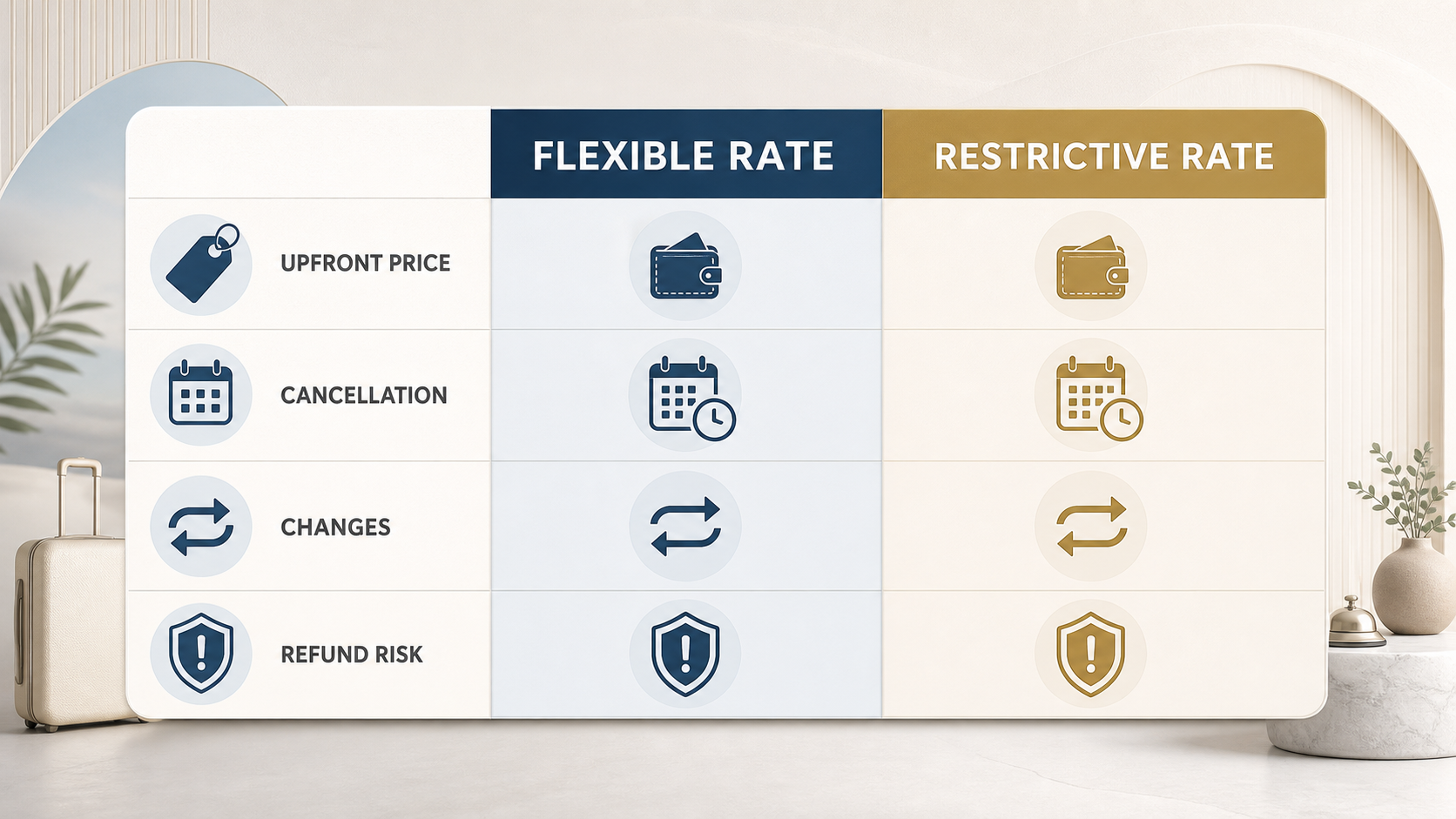 Two prices can be compared only when they cover the same stay on the same terms. Start with the basics: hotel, dates, room type, bed configuration where relevant, occupancy and included meals. Then compare the total amount due, shown taxes, mandatory fees, currency, payment timing, deposit or pre-authorisation requirements, and the cancellation and no-show rules.
A rate that looks cheaper may be less flexible, exclude breakfast, require earlier payment or apply a different refund deadline. Conversely, a higher displayed amount may include something that changes the practical value of the stay. Compare the final total and the written conditions, not just the first nightly figure.
Rate-comparison visual: Review equivalent OTA and hotel-direct rate cards for total price, taxes, cancellation, room type, breakfast and membership benefits.
There is also a regulatory reason to avoid assuming that every channel must show the same offer. The European Commission states that, from 14 November 2024, the Digital Markets Act prohibits parity clauses for Booking.com, allowing relevant travel-service providers to offer different prices and conditions on their own sites or other channels. That creates an opportunity to compare, but it is not a guarantee that direct booking will be cheaper in any individual case. European Commission guidance
The UK Competition and Markets Authority’s closed monitoring record provides earlier context: it documents changes to wide parity commitments and continuing monitoring in the UK, rather than a universal promise about today’s rates. UK CMA monitoring record
Finally, check the booking confirmation for the named booking party and the instructions for changes, cancellations, refunds and support. Those written terms are the practical basis for the reservation you are about to make.
Choose the booking route that fits your trip
AI-generated generic editorial illustration — not a retailer product photo and does not depict the reviewed product or service. Support the practical decision path without prescribing one booking route.
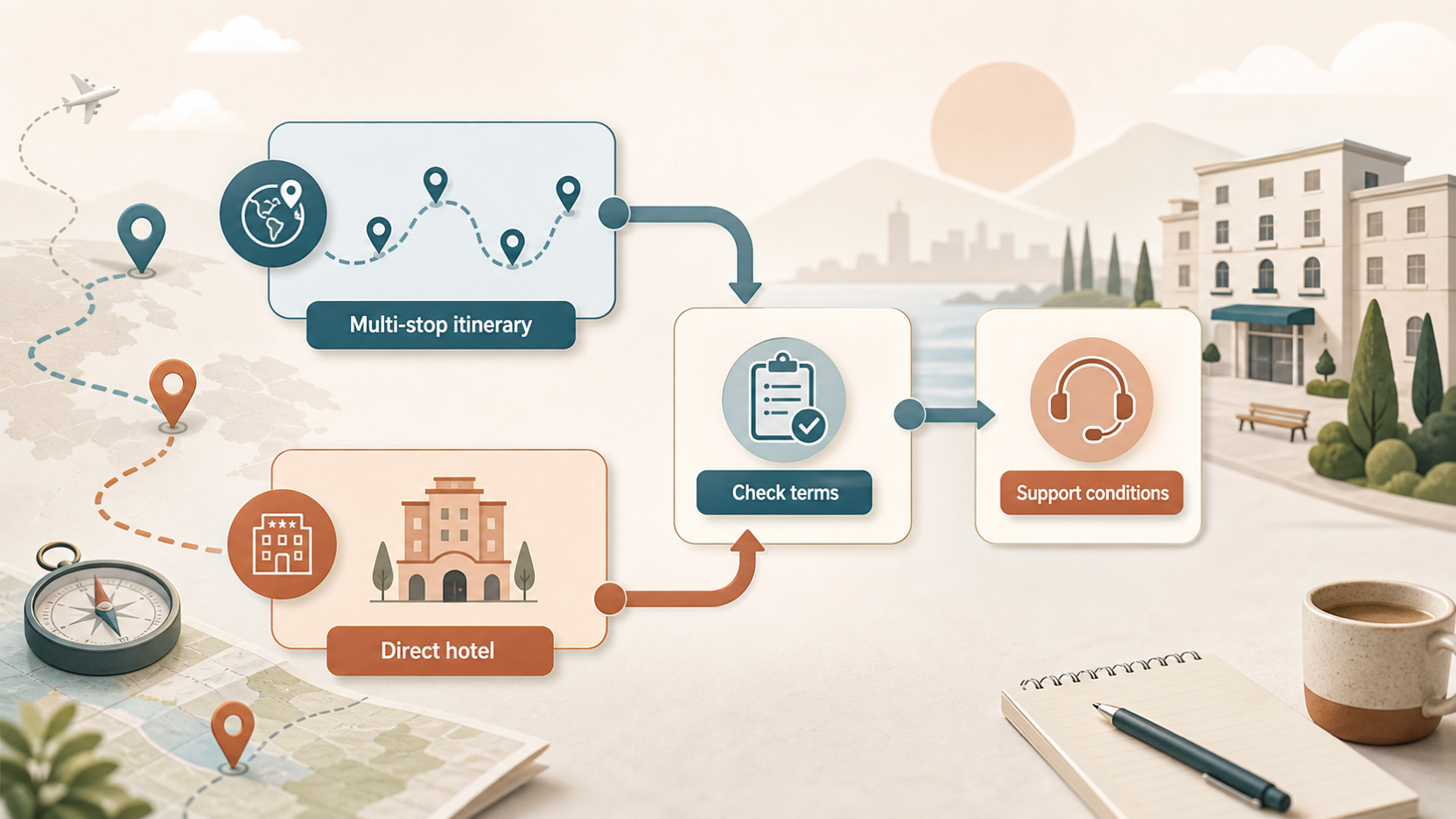 Start with the shape of the trip. If you are comparing several cities, dates or property types, an OTA search may be an efficient way to map the options and keep provisional choices together. If you already know the hotel and want to review its own offers or raise a property-specific question, opening the hotel’s site may be equally useful.
Then run the same comparison whichever route you began with. Match the dates, guest count and room category, and read the final rate conditions. Choose the offer whose total cost, payment schedule and cancellation rules you can accept—not simply the channel with the most attractive first number.
Booking-route visual: Start with either multi-stop search or a direct hotel relationship, then converge on the final rate terms and support conditions.
For a trip with uncertain plans, give extra attention to the cancellation deadline, refund method and contact route. For a fixed, simple stay, your priorities may be a clear total price and the inclusions you expect. If loyalty matters, verify the programme’s own rules for the selected rate rather than assuming that one booking channel always earns or excludes benefits.
Before completing payment, save the confirmation, rate conditions and any written reply to an important question. These records make it easier to identify the reservation details and the right support route later.
Frequently Asked Questions
Is it always cheaper to book a hotel directly?
No. The European Commission notes that providers using Booking.com can offer different, including better, prices and conditions on their own sites or other channels under the DMA rules. That means comparison is worthwhile; it does not establish that direct booking is always cheaper. Compare equivalent final rates for your dates. European Commission guidance
For a like-for-like check, use the same room category, guest count, dates, currency and cancellation deadline on each channel. Include mandatory taxes and fees before deciding which offer costs less. A lower headline amount can be less useful if it has a stricter cancellation rule, excludes breakfast, requires prepayment, or applies different change conditions. Save a screenshot or copy of the final booking page before payment, especially where the price display changes after you select a room. This gives you a practical record of the rate, inclusions and deadline you accepted.
Can a hotel match or improve an OTA rate?
A hotel may offer different prices or conditions through its own site or other channels, but whether it will match or improve a specific rate depends on the hotel and the rate terms. Ask the hotel if needed, then rely on the written offer and final booking conditions.
When contacting the property, provide the exact stay dates, room type, number of guests and the OTA rate you are comparing. Ask whether any direct alternative has the same cancellation policy and inclusions, rather than asking only for a lower price. If the hotel responds by email or message, check that the property details, total amount, payment timing and cancellation terms are clear before relying on the offer. Do not assume that an informal assurance changes the terms shown during checkout.
Who should I contact if I need to change or cancel a booking?
Check the confirmation first. It should identify the booking party and set out the applicable change, cancellation, refund and support instructions. Use that route rather than assuming the hotel or the OTA is responsible in every case.
Act before the relevant deadline and keep the confirmation number, any cancellation reference and copies of your messages. If you need help, describe the requested change precisely and ask for written confirmation of the outcome. A successful cancellation request, a refund timeline and a room-date change are separate points to check. Reviewing the confirmation and the final response together can reduce avoidable confusion when plans change.
Should I book through an OTA to earn loyalty benefits?
Check the loyalty programme’s rules and the selected rate’s conditions before booking. Benefit eligibility can depend on the programme, the property and the booking type, so it should be verified for the exact stay rather than assumed from the channel alone.
Before paying, compare the value of any expected benefits with the complete rate and flexibility of the alternative booking. Check whether the reservation is eligible for points, qualifying nights, member pricing, breakfast, upgrades or other benefits that matter to you. If an OTA listing mentions a reward, read its own conditions as well as the hotel programme’s terms. Keep the final confirmation because it identifies the channel, rate and reservation details you may need if you later ask about eligibility.
Related reading
- Best hotel booking sites: evidence-led picks for different kinds of trip
- Booking.com review: strengths, limits and practical alternatives
- How to choose a hotel booking site for your trip
- When to book a hotel for better value: timing, flexibility and rate conditions
Editorial information: About our editorial team · Read our editorial policy · Read our affiliate disclosure.