A hotel rate is not simply a price: it is an offer with a room description, a total payable amount and rules about payment, cancellation and changes. Booking earlier can be useful when it helps you secure a suitable room on terms you can live with. It does not make a temporary displayed rate a guaranteed saving.
The practical goal is to compare offers on the same basis, then choose the amount of flexibility that matches how settled your plans really are.
Start with the total cost and the rate rules
AI-generated generic editorial illustration — not a retailer product photo and does not depict the reviewed product or service. Make the full-cost comparison framework immediately scannable before readers assess headline rates.
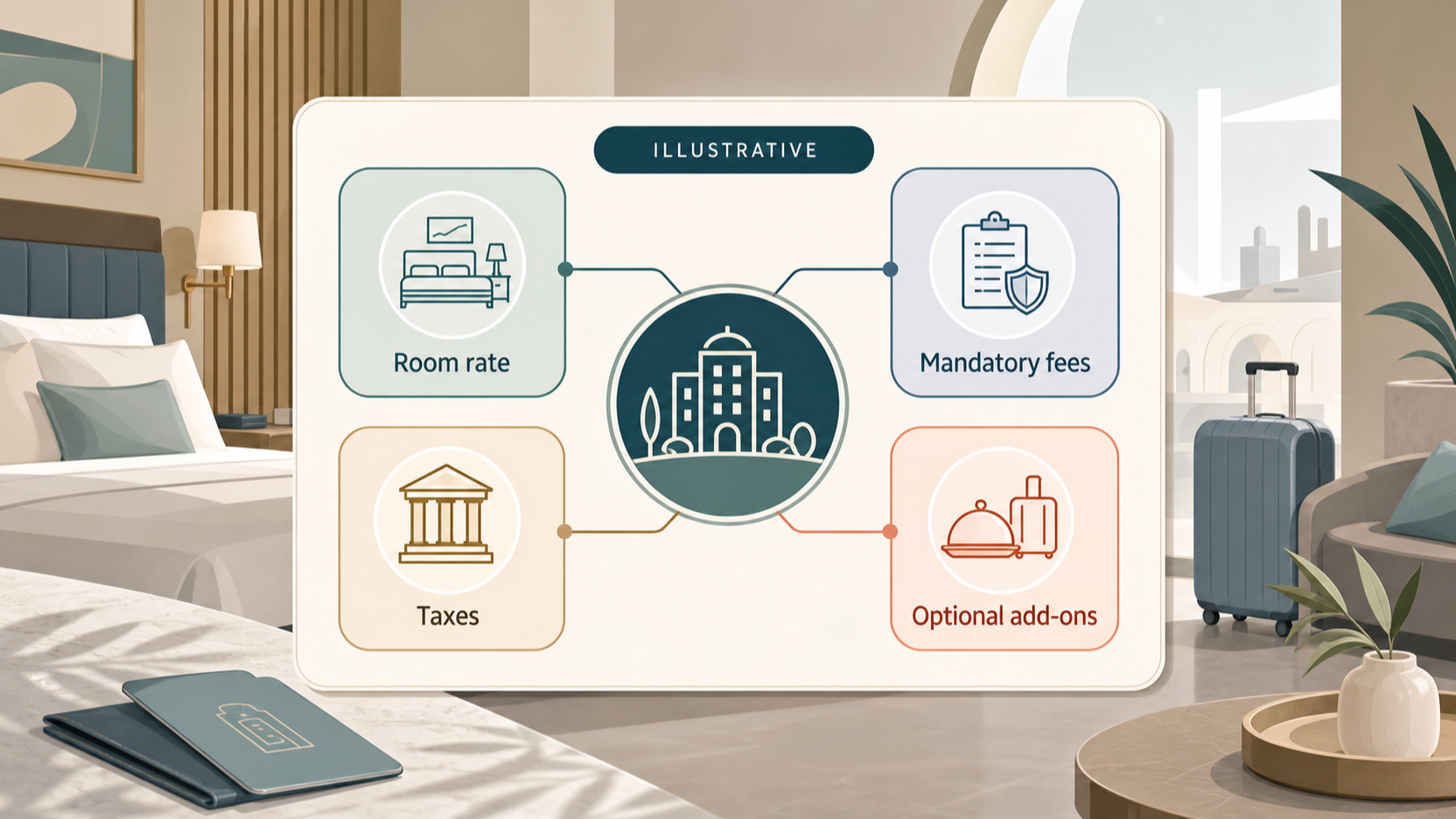 Start with the total payable price for the exact stay, not the first nightly figure shown in search results. Check the currency, number of nights, occupancy, taxes and any mandatory charges before deciding that one offer is cheaper. Optional extras matter too, but keep them separate from charges you cannot avoid if you take the room.
This is more than tidy budgeting. The US Federal Trade Commission’s rule on unfair or deceptive fees for short-term lodging requires businesses advertising prices to disclose total prices and fees up front; it does not ban fees or a particular pricing strategy. FTC announcement That makes a clear final total a useful starting point for comparison, even where individual bookings have different inclusions.
Then read the rate rules before you treat the price as good value. Note whether payment is taken now or later, the cancellation deadline and time zone, whether changes are allowed, and what happens if you do not arrive. A lower displayed price can be useful, but only if the conditions also suit the trip.
What booking early can help you secure
Booking early is often most useful for securing an acceptable option while you still have time to compare it carefully. That might mean a room type you need, a location that works for your itinerary, or a rate whose cancellation terms leave room for plans to change.
Think of an early booking as a way to create options rather than a prediction about where prices will go. If you find a suitable refundable rate with a clear total, you may be able to reserve a workable plan and revisit it later within the cancellation terms. If the trip is fixed and the restrictive rate’s terms are acceptable, you may instead value the lower immediate commitment.
Record what you are comparing: property, room or bed type, occupancy, dates, inclusions and conditions. A room that looks identical in a search list may have different breakfast, payment, cancellation or change terms when opened.
Avoid treating scarcity prompts as proof that an offer is uniquely good. They can be a reason to check availability promptly, but they should not replace checking the final price and the rules that apply to your booking.
Put flexible and restrictive rates on the same footing
AI-generated generic editorial illustration — not a retailer product photo and does not depict the reviewed product or service. Help readers compare rate conditions on the same footing instead of focusing only on the initial displayed price.
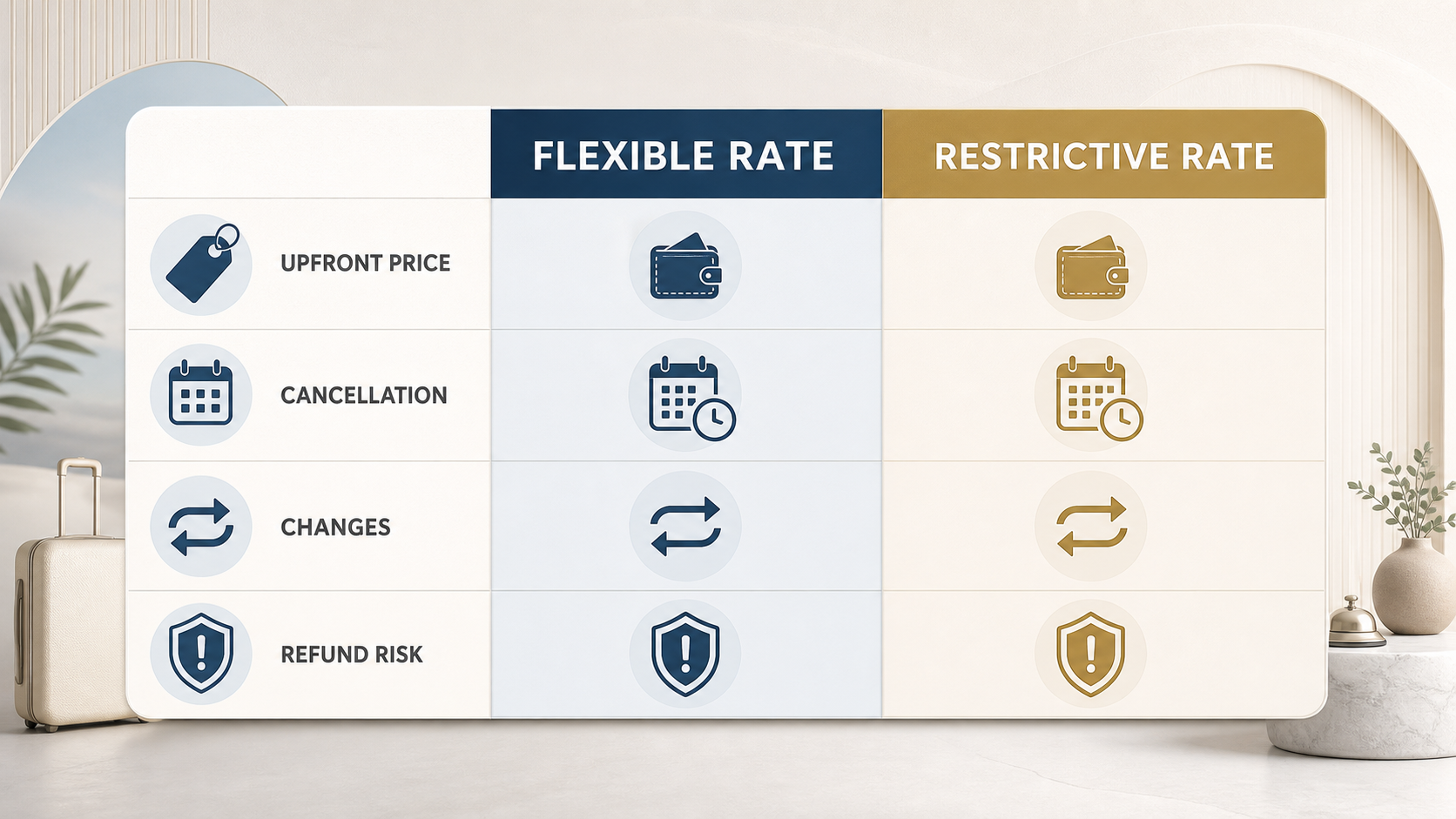 A flexible rate and a prepaid or non-refundable rate are different products, even when they cover the same room and dates. The restrictive rate may cost less upfront, but it can shift more of the financial risk of cancellation or changes to you. Compare the saving with the cost you could face if your plans move.
Use four questions:
- What is the total payable amount for each rate?
- When is payment taken?
- What is the last time to cancel without a charge?
- What refund, change or no-show cost applies after that point?
The right choice depends on your certainty. A non-refundable rate can be reasonable when dates, transport and travellers are settled and the saving is meaningful to you. A flexible rate can be worth more when visas, work, health, connecting travel or group arrangements remain uncertain. The comparison is not “cheap versus expensive”; it is “what is the saving, and what risk am I accepting for it?”
Do not assume that a label settles the question. Read the property-specific terms shown for the selected rate. “Free cancellation” may have a deadline, and “pay at property” may still come with a cancellation or no-show charge.
Use a like-for-like rate comparison checklist
Make a short comparison note before booking. It reduces the chance that a low headline rate distracts from a material difference in the offer.
For every option, capture:
- The exact property, room type, dates and number of guests.
- The displayed total, currency, taxes and mandatory charges.
- Included items such as breakfast, parking, Wi-Fi or transfers, where relevant to your stay.
- Payment timing and whether any payment is refundable.
- The cancellation deadline, including its stated local time and time zone.
- Change, no-show and early-departure terms.
- Any discount conditions, membership requirements or other eligibility limits.
The UK Competition and Markets Authority identified promotions, scarcity messages, hidden charges and disclosures about commission affecting search-result order as consumer-protection issues in the online accommodation-booking sector. CMA case and sector principles That is a useful prompt to look past a badge, crossed-out price or prominent ranking and verify the information that actually changes your cost or choice.
If two offers differ, state the difference in plain language. For example: “£18 less, paid now, no refund after booking” versus “pay later, cancel until 18:00 local time two days before arrival.” This makes the trade-off visible and lets you decide whether the difference is worth it.
Treat price prompts and promotions as information to verify
Promotions and urgency messages can help surface an offer, but they are not a substitute for the booking-page details. Before you commit, check the final price for your selected dates and occupancy, whether taxes and mandatory charges are included, and whether the promotion applies to the rate you have chosen.
Also check the conditions attached to the apparent discount. A member-only rate, prepaid offer, limited-change fare or rate tied to a particular payment method may still be useful; it simply needs to be compared against alternatives using the same room, stay and occupancy.
The CMA’s work in this sector specifically addressed the use of promotions and scarcity messages, hidden charges, and the disclosure of commission where it affects search-result ordering. CMA case and sector principles The FTC rule likewise focuses on truthful up-front disclosure of total prices and fees in short-term lodging. FTC announcement
A sensible pause before payment is therefore simple: confirm the room, total, rules and any promotion conditions on the final booking screen. Save the confirmation and the applicable terms so you can refer back to what was booked.
Choose a booking and review strategy that matches your plans
Match your strategy to the certainty of the trip. If dates are still fluid, prioritise clear flexible terms and put the cancellation deadline in your calendar. If plans are firm, compare restrictive and flexible totals and choose the risk level you are comfortable carrying.
Review the booking when a relevant part of the trip changes: flights are confirmed, a visa is issued, another traveller drops out, or the cancellation deadline approaches. Re-checking does not mean assuming a later price will be better. It means deciding whether your existing booking still fits your plans and whether any alternative is genuinely comparable.
Keep the review disciplined. Compare the same dates, occupancy and room type, include mandatory charges, and read any new rate’s terms before cancelling an existing reservation. If you have a flexible booking, do not cancel it until you have confirmed that a replacement is available on acceptable terms.
This approach avoids two common mistakes: chasing a lower number that carries unsuitable restrictions, and holding a flexible reservation past a deadline without making an intentional choice.
Frequently Asked Questions
Is it always cheaper to book a hotel early?
No. Booking early can help you secure a suitable room and terms, but a displayed price at any moment is not a guaranteed saving. Compare the current final total and conditions with your own need for flexibility rather than relying on a universal booking window.
Should I choose a refundable hotel rate or a non-refundable rate?
Choose based on the value of the saving and the likelihood that your plans will change. A non-refundable rate may suit firm plans; a refundable rate may be worth more when the cost of cancelling or changing would be difficult to absorb. Compare payment timing, cancellation deadlines and all change or refund terms.
What fees should I check before booking a hotel?
Check the total price for the selected stay, taxes and mandatory charges, then distinguish optional add-ons from charges required to take the room. The FTC’s short-term-lodging rule focuses on up-front disclosure of total prices and fees, which is a useful standard for a careful comparison. FTC announcement
Can I re-check prices after making a flexible booking?
Yes, provided you follow the booked cancellation terms. Compare a potential replacement like for like, confirm its final total and rules, and keep the existing booking until the replacement is confirmed. Re-checking is about preserving a suitable option, not assuming that a later price will necessarily be lower.
Before booking, compare your shortlist on final cost, payment timing and cancellation terms—then choose the rate that leaves you comfortable with the remaining risk.
Related reading
- Expedia review: who it suits and when another booking route is better
- Hotels.com review: accommodation focus, rewards and booking trade-offs
- Hotel booking sites vs booking direct: how to compare the real trade-offs
- How to identify genuine hotel deals without overlooking fees and conditions
Editorial information: About our editorial team · Read our editorial policy · Read our affiliate disclosure.