A tempting hotel price is only the start of the decision. A genuine deal is one you can book on terms that suit your trip, with mandatory costs accounted for and no important differences hidden in the comparison. Use the same dates, guests and room requirements throughout; then work through price, flexibility, room details, reviews and the hotel’s direct offer in that order.
What Counts as a Genuine Hotel Deal
A genuine hotel deal is not simply the lowest number on a search-results page. It is the best overall value among offers that are actually comparable and bookable for your stay. Start with the final mandatory cost, then check whether the rate has the same cancellation, payment and room conditions as the alternative you are considering.
That approach matters because accommodation-booking practices can make a price look more attractive than it is. UK Competition and Markets Authority guidance identifies misleading discount claims and hidden charges as practices that can harm customers. In the United States, the Federal Trade Commission’s rule on unfair or deceptive fees covers short-term lodging and focuses on giving consumers total-price and fee information up front.
Treat a deal as a small decision checklist rather than a percentage-off label. Ask: What must I pay? What happens if plans change? Is this the same room and occupancy? Are useful benefits included? Do recent reviews expose a problem that would change my choice? Finally, compare the direct hotel offer on the same basis.
For a wider view of where to search, see our hotel booking platform comparison.
Compare the Total Price Before the Discount
AI-generated generic editorial illustration — not a retailer product photo and does not depict the reviewed product or service. Make the total-price comparison method immediately scannable and reinforce that the advertised rate is not the final comparison point.
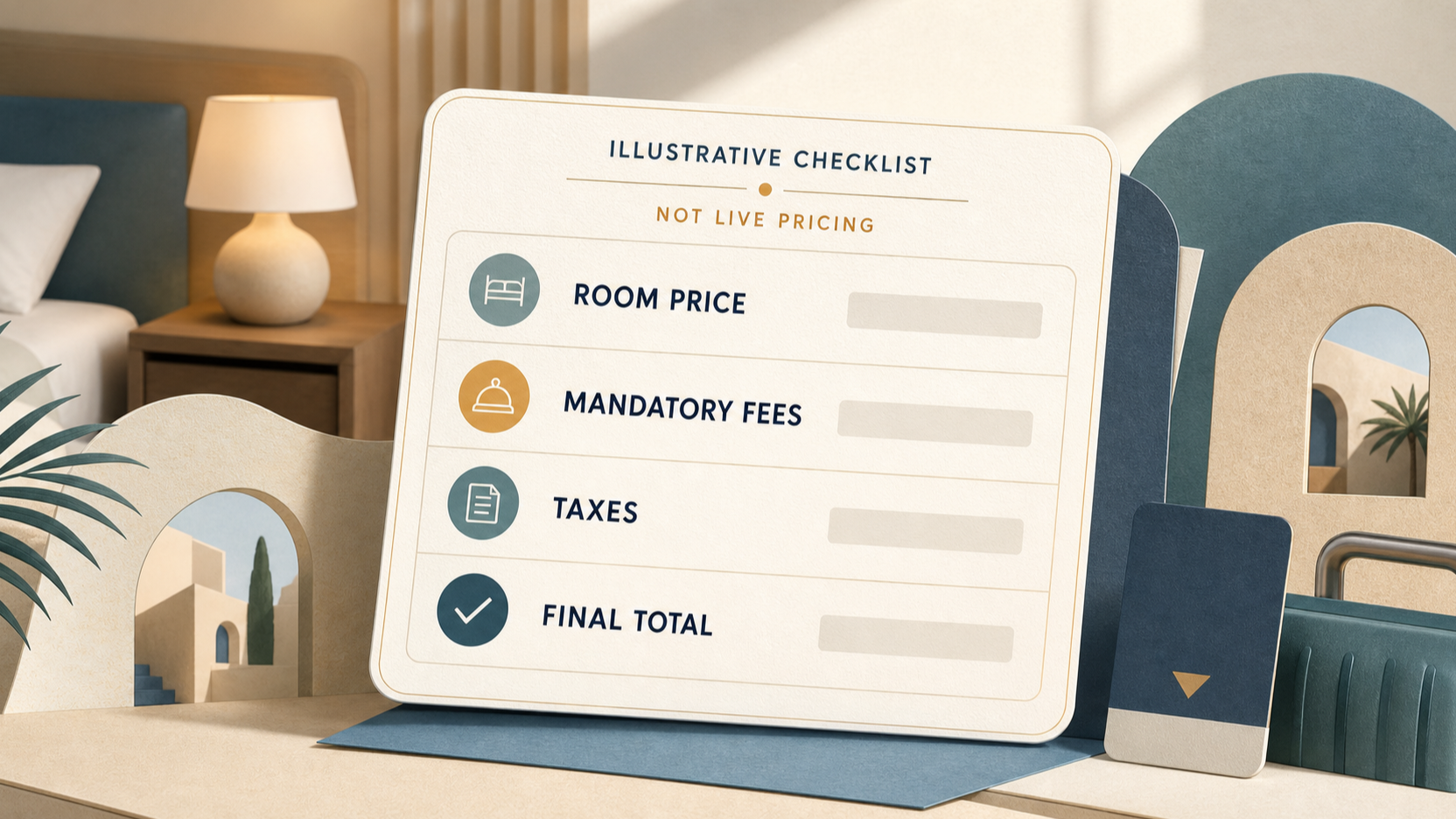 Compare the amount you would have to pay for the same stay, not the crossed-out price or the nightly rate alone. Go as far through each booking flow as needed to identify mandatory charges and the final total before committing. Keep the number of nights, dates, guest count and currency the same while you compare.
Separate costs into three groups:
- The advertised room rate.
- Mandatory charges, such as required taxes or compulsory property fees where shown.
- Optional extras, such as parking, breakfast upgrades or other add-ons you can decline.
Only the first two groups belong in the core total-price comparison. Optional extras can still matter, but they should not make one rate appear higher unless you would choose the same extra with both bookings. If one offer shows tax included and another adds it later, compare the final payable figure rather than trying to judge the headline numbers.
Currency can also distort a quick comparison. Check the currency displayed at checkout and whether your payment provider may apply a conversion charge. Do not assume a familiar currency symbol means identical treatment across two sites.
A simple rule helps: if you cannot identify the mandatory total, you do not yet have a reliable price comparison. The UK CMA guidance specifically addresses hidden charges in online accommodation booking, while the FTC’s short-term-lodging rule is directed at clear, up-front total-price and fee information.
For help fitting accommodation into the rest of the trip, see our travel budget planning guide.
Use Booking Details That Make Deals Easier to Compare
A comparison becomes useful only when both offers describe the same stay. Set the same check-in and check-out dates, number of guests and number of rooms before looking at the price. Then compare the room name and description closely: a similarly named room may differ in bed configuration, view, size, accessibility features or occupancy rules.
Check the rate details as well as the room. Look for whether breakfast, Wi-Fi, parking, resort access, taxes or other benefits are included, optional or excluded. A slightly higher rate may be better value if it includes something you would otherwise buy; a cheaper rate is not equivalent if it leaves out something you need.
Use the booking page to confirm the deal rather than relying on search snippets, badges or a percentage discount. The CMA’s guidance for accommodation-booking sites emphasises transparent customer information and addresses misleading discount practices. For travellers, the practical lesson is straightforward: compare like for like before treating a displayed saving as real.
Make a short side-by-side note for each option: room, guests, dates, inclusions, total, cancellation and payment timing. If any field differs, decide whether that difference is worth the price gap instead of calling it a direct saving.
For room terminology and trade-offs, see our guide to choosing a hotel room.
Check Cancellation and Payment Conditions
A lower price can come with a less flexible agreement. Before choosing it, find the cancellation deadline, any charge for cancelling after that point, whether amendments are allowed and when the property will take payment. These conditions can change the value of a rate even when the room and total are otherwise identical.
Non-refundable rates can work when your plans are settled and the saving is meaningful to you. They are a trade-off, not an automatic bargain: you may lose the payment if your trip changes. A flexible rate can be worth more if flights, visas, work commitments or travel companions are uncertain.
Also compare payment timing. One booking may require payment now while another charges later; that affects cash flow and how easily you can change plans. Read whether the property, rather than the booking site, will collect payment and whether any stated conditions apply to your card or arrival.
Do not let a large discount label override the rate rules. The CMA guidance highlights the potential consumer harm from misleading sales practices in online accommodation booking. A clear comparison records the price and the flexibility together, so you know what you are giving up for a lower total.
For a fuller walkthrough, see our hotel cancellation policy guide.
Match the Room and Included Benefits
Room labels are not standardised across every property or booking channel. Compare the room description, bed setup, maximum occupancy and stated view or location before assuming two offers are equivalent. A lower-priced option may be a smaller room, a different bed type, a room with restricted views or a rate intended for a different number of guests.
Then list the included benefits that affect your own stay. Breakfast, parking, airport transfers, lounge access, loyalty benefits and late checkout can all change value, but only if the booking terms state that they are included. Do not count a benefit based on a general hotel description when the rate details do not confirm it.
If one rate includes an item you would otherwise purchase, add its cost to the alternative before deciding which deal wins. If you would not use it, leave it out. This keeps the decision tied to your needs rather than a promotional bundle.
A good comparison is specific: same room or an acceptable substitute, same guests, same dates, same mandatory cost and a clear list of differences. For help decoding common labels, see hotel room types explained.
Use Reviews to Test the Value Behind the Price
Price tells you what you pay, not whether the stay suits your priorities. Read recent guest feedback to test the value behind the offer, especially when a rate is much lower than nearby alternatives. Focus on comments that relate to what you need: cleanliness, noise, location, room condition, accessibility, Wi-Fi or staff responsiveness.
Look for patterns rather than treating one very positive or negative review as decisive. Several recent comments about the same issue may be more useful than an older overall score. Pay attention to whether reviews discuss the room category you are booking, since a property can have meaningful differences between room types.
Reviews cannot guarantee your experience, and they should not replace reading the booking conditions. Use them as a practical check on the trade-off: a saving may be worthwhile for a short overnight stay but not for a trip where quiet, workspace or reliable transport access matters.
Keep the evidence in proportion. A review signal is a reason to investigate further, not proof that every stay will be the same. For a methodical approach, see our guide on how to read hotel reviews.
Check the Hotel’s Direct Rate Last
Once you have identified a comparable booking-platform option, check the hotel’s own website using the same dates, guests and room type. Compare the final mandatory total, cancellation rules, payment timing and included benefits—not just the first rate shown.
A direct booking is not automatically cheaper, and a platform price is not automatically better. The direct offer may include a different room condition, a member-only rate or benefits that make it better value for you. Equally, the platform may have the lower comparable total. The useful question is which offer gives you the better overall outcome on the terms you want.
Take a final screenshot or note of each offer’s key details before booking. This helps avoid accidentally selecting a different rate when you return to complete the reservation. If the direct offer differs, identify why: room, inclusions, cancellation, payment schedule or mandatory charges.
For more context on the trade-offs, see the benefits of booking hotels direct.
Frequently Asked Questions
Why can a hotel’s final price be higher than the first price shown?
The first price may not include every mandatory charge displayed later in the booking process. Taxes or compulsory fees can affect the final total, while optional extras should be considered separately. Compare the total you must pay for the same stay rather than the headline nightly rate. UK CMA guidance addresses hidden charges in online accommodation booking, and the FTC’s short-term-lodging rule focuses on clear, up-front total-price and fee information.
Should I choose a non-refundable hotel rate to save money?
Choose it only if the saving is worth the loss of flexibility for your situation. Check whether changes are allowed, when cancellation becomes chargeable and when payment is taken. A flexible rate can be better value when your travel plans could change; a non-refundable rate can suit a settled trip when you understand the risk.
Is booking directly with the hotel always cheaper?
No. Compare the hotel’s direct offer and the platform offer using the same dates, guests, room and conditions. Either channel can provide better value once mandatory costs, cancellation rules, payment timing and included benefits are considered.
How can I compare hotel deals when taxes and fees are shown differently?
Continue each comparison until you can see the mandatory final total, then record the currency and what is included. Keep optional add-ons separate unless you would buy the same add-on with both offers. If you cannot establish the mandatory total for one option, treat the comparison as incomplete.
For a final pre-booking checklist, see our hotel booking tips.
Sources
Related reading
- Trip.com review: hotel booking strengths, limits and trip fit
- How to choose a hotel booking site for your trip
- Hotel booking sites vs booking direct: how to compare the real trade-offs
- When to book a hotel for better value: timing, flexibility and rate conditions
Editorial information: About our editorial team · Read our editorial policy · Read our affiliate disclosure.